
The Anatomy of the Eye Explained
The human eye is one of nature’s most intricate and fascinating organs. It captures light, focuses it precisely, and sends detailed images to the brain, allowing us to see and interpret the world around us. To understand how diseases like glaucoma affect vision, it helps to first understand how this remarkable structure works.
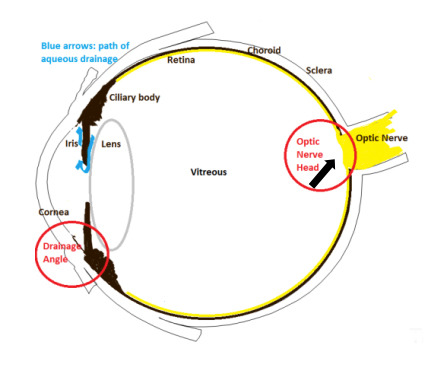
The eyeball has three main layers.
The outermost layer is tough and protective. In the front, it forms the cornea, which is clear and curved like a window that allows light to enter. The rest of the outer coat is called the sclera, which is white and opaque, giving the eye its recognizable shape.
Beneath this lies a coloured and vascular layer known as the uveal tract, made up of the iris, ciliary body, and choroid. The iris is the coloured part of the eye and has a central opening called the pupil, which controls the amount of light that enters the eye. Behind the pupil sits the natural lens, which helps to focus light onto the retina.
The space behind the lens is filled with a clear, jelly-like substance called the vitreous, which maintains the eye’s shape and optical clarity. The innermost layer of the eye is the retina, a thin, delicate nerve layer that senses light and sends signals to the brain. Fibres from the retina bundle together to form the optic nerve, and the point where they converge is called the optic nerve head. This area is crucial, as it is the primary site of damage in glaucoma.
The eye maintains its round shape due to pressure from a fluid known as the aqueous humour. This fluid is continuously produced by the ciliary body behind the iris, flows through the pupil, and drains out through a specialized structure called the drainage angle.
To ensure this balance, two tests are commonly performed: tonometry, which measures eye pressure, and gonioscopy, which uses a special lens to examine the drainage angle.
Understanding this delicate system helps us appreciate why any blockage or imbalance can have significant consequences for vision. Glaucoma directly affects the optic nerve and can gradually lead to loss of sight if not detected early.